
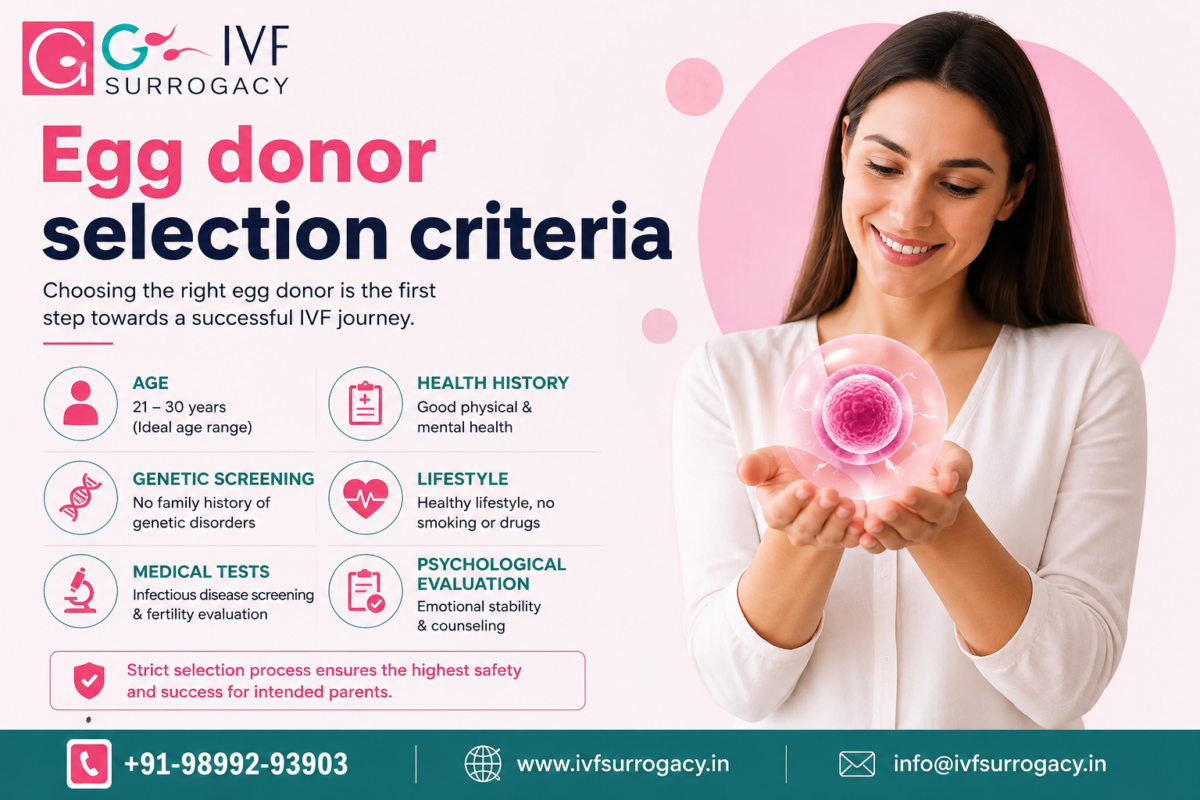
Egg donor selection criteria
Every year in India, about 2,50,000 to 3,50,000 IVF cycles are performed yearly. Among them, about 25,000 to 50,000 are donor egg IVF cycles.
Meaning, simply about all the IVF cycles that are performed in India yearly, about 15% of them are from egg donor IVF procedures..
But, first, let’s understand what is the meaning of egg donation means.
Many people have doubts about what donor IVF is and whether we actually need it or not. There is a different demand for it and very different answers for it.
Egg Donation is a process where a healthy young woman who is typically known as a donor provides her own egg to help another person or a couple, meaning the intended parents, conceive their babies.
How? IVF is the medical procedure; in this procedure, a medical expert actually assists you through your whole process of conception of the baby.
Fertilization is the process that happens when the gametes, such as an egg and a sperm, meet. This results in the formation of an embryo. In natural pregnancy, this process happens inside the body of the woman; however, there could be many reasons that the fertilization is being restricted. The doctors actually fertilize the embryo in the laboratory in the treatment of IVF.
Typically, the eggs and the sperm are from the intended parents themselves; however, in many cases the infertility is directly linked to the quality of the egg and the quality of the sperm from the intended parents. In those cases, things could take a different path. So doctors actually suggest the egg process.
The main difference between the standard IVF process and egg donor IVF is whose egg is being used. Let’s say the infertility is because there is a problem with the eggs of the intended mother, so the intended parents could actually opt for an egg donation process where a young, healthy woman provides her own egg to help the couple conceive their baby through IVF. To opt for an egg donation programme in India, you cannot simply take eggs from any woman; there are complete rules and regulations we have considered. There is a
Who needs egg donor IVF?
Egg quality and quantity
The best reason is that many women who reach their late thirties or forties have egg quality and quantity issues. In these cases, a donor egg from a typically young woman between 21 and 30 years old provides the highest chance of a good implantation rate and live birth.
Low number of Ovarian reserves
Second reason: although ovarian reserves of women start to diminish with age, some women from the start have a very small number of eggs remaining in their ovaries regardless of their age, which can make it difficult to produce enough eggs during the process of standard IVF for the egg retrieval process.
Premature menopause
Another reason is premature menopause; it is when the ovaries overall stop functioning before the age of 40, which is very common in some women.
Multiple previous IVF attempts
Another reason why the doctors actually suggest that you choose the donor egg program is based on the medical conditions of the intended parents.
Like if there are there has been previous unsuccessful IVF cycles, doctors may recommend the donor egg program. This is due to poor embryo development or failed implantation
Cancer patients
Another reason to get an IVF donor program is Cancer patients. Those who undergo chemotherapy or radiation therapy can actually permanently damage or decrease a woman’s egg supply. In these cases, the Donor egg is one of the best choices for women wanting to have their own baby.
Endometriosis
Endometriosis also becomes the next best reason to have a donor program. Because if someone has severe endometriosis or any kind of ovarian cancer, the doctors actually surgically remove the ovaries, which makes it difficult for further family planning.
Genetic conditions
If any of the intended period specially the intended mother, has any kind of severe genetic or hereditary conditions lor chromosome and abnormality, the baby who is going to be born through the IVF procedure is going to have that condition as well, so to decrease or to eliminate the risk of passing that condition to the child, donor IVF is the best option.
Single men
In many countries, single fathers or single men can choose to become a single parent via surrogacy, which requires a donor program to create embryos. However, it is not legal in India; a single man cannot choose to be a single parent via surrogacy via VF; in any case, it is prohibited.
Same-sex couples
However, in other cases, like if same sex couples can’t be exclusive, you don’t have programs to achieve their family planning.
Egg donation rules in India: you have to consider before moving towards Donor IVF.
Age eligibility criteria for the
Age & Eligibility Criteria
Both the intended parents and the egg donor must meet specific age and demographic rules set by law
| Party | Age Limit | Legal Requirements |
| Intended Mother | 21 to 50 years | Married woman or single woman (unmarried/single, divorced, or widowed). |
| Intended Father | 21 to 55 years | Must be legally married to the intended mother. (Single men cannot avail ART services in India). |
| Egg Donor | 23 to 35 years | Must be/have been married, with at least one living biological child of her own (at least 3 years old). |
- Once-in-a-Lifetime Donation:
- Cap on Eggs Retrieved:
- No Commercial Trading: