
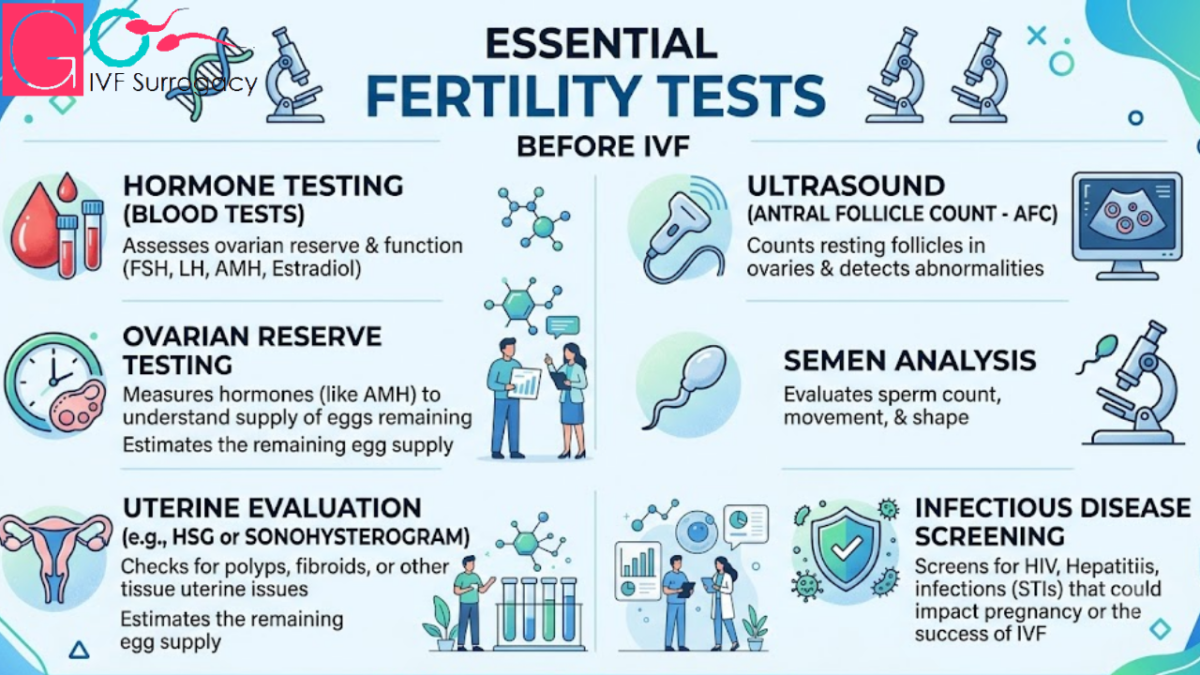
Essential fertility tests before IVF
What is the IVF process in Nepal?
IVF is known as in vitro fertilisation, meaning fertilisation that takes place outside the body. Fertilisation, which is the fusion of the egg and the sperm, is a result of intercourse. In this article, we explain how IVF treatment works and whether you even need it.
IVF is a simple treatment where doctors perform a minimum month-long regimen to let your body be ready to have the baby. Additionally, there are different phases in this treatment; however, the basic phases are these five.
First consultation/initial tests: Of course, every couple needs to have the first counseling session with an IVF expert. This is the phase where you have Essential fertility tests are done before IVF. They will make sure to find out the exact reason for your infertility and the inability to have a child. This is done through several tests, like AMH.
Ovarian stimulation: This is the process in which the eggs of the female partner are stimulated through a series of injections so that her ovaries can produce multiple eggs at once. Usually, a female’s body only releases one egg per month, but because of these drugs, such as FSH, also known as follicle-stimulating hormone, and LH, luteinizing hormone, all of which are encouraged to produce and release more than one egg, preferably 8 or 10.
Egg retrieval: In the egg retrieval process, doctors perform a small surgery known as transvaginal oocyte retrieval (TVOR). It is a very minor surgery, so you can go home on the same day. Doctors use the ultrasound device so that they can see the actual image inside your body.
At first, they insert a thin, hollow needle, which is attached to the ultrasound device. This needle is gently passed through your vaginal wall and enters directly into your ovaries. Then the doctors gently vacuum the follicle fluid containing the eggs. This process takes about 45 minutes.
Whereas if the men’s sperm is needed, they are extracted through masturbation. However, if there is a problem with male fertility, doctors could perform surgery to retrieve the sperm directly. The names of the surgeries are PESA, MESA, and many more.
Fertilisation and Embryo Culture: The next process is actually fertilizing the collected egg and the collected sperm. There are two methods. The first is the conventional method, where thousands of sperm are placed in the same spot with or without only one egg. The second method is Intracytoplasmic Sperm Injection (ICSI). After fertilization has occurred, the embryo phone so the doctors will now transfer it into the incubator.
An incubator is a device that behaves as an artificial woMB or uterus. Till the embryo has reached a state where it is healthy and strong enough to be transferred to the actual uterus of the intended mother. Some people actually freeze their fertilized, healthy embryos for future use.
In some cases, when the timing is not right and when individuals want to focus on their careers or due to any medical conditions, they could actually use this frozen embryo for further embryo transfer when they want to have children in the near future.
Embryo transfer: The last stage in this process is embryo transfer, in which the embryo is healthy enough. The doctors actually transferred this embryo to the uterus. There are two types of embryo transfer: the first is Fresh embryo transfer, and the second is frozen embryo transfer, which we have talked about earlier.
In the fresh embryo transfer process, first of all, doctors prepare the bladder so they can actually see the full display, so the doctors can actually see the uterus in full display through the ultrasound device. Then, a very thin, flexible plastic tube known as a transfer catheter is used. This catheter has embryo liquid.
This tube is inserted into the vaginal wall and passes directly through the cervix till they reach the uterine cavity. The uterine cavity is the place where the embryo attaches itself to the mother’s uterus. The uterine cavity actually provides nutrients and essential oxygen levels to the baby. Through the blood of the mother.
When doctors reach the uterine cavity, they gently release the embryo’s fluid into it. This surgery is a very low-impact surgery. After surgery, patients typically rest for about 10 to 15 minutes before heading home.
Why are Essential fertility tests done before IVF important?
Doing the tests before your IVF treatments is similar to laying out the blueprint of the house. The only and biggest reason to do the essential fertility tests before IVF is to determine the definite cause of the couple’s or individual’s infertility.
Let’s go through how essential fertility tests are done before IVF.
To customize the medical dosage:
Essential fertility tests are done before IVF because infertility can be caused by many factors, such as low ovarian reserves, meaning low eggs in the ovaries of the female partner. Another factor that can cause infertility is a low sperm count in the male partner. Every infertility factor can cause different types of treatment needs. Couples with low sperm count and conditions like azoospermia can choose the ICSI type of fertilisation in the IVF process. It will save you lots of time, effort, and money.
Check the uterus environment
Also, in Essential fertility tests, which are done before IVF the thing is, during the IVF process, in the stage of Embryo transfer, the uterus’s thickness lining. The normal thickness for endometrial is 7- 12 mm; anything below 7 is considered not safe for efficient implantation. The uterus consists of spiral arteries, which are essential for delivering nutrients, hormones, and oxygen to the growing embryo.
With age, the quality of these arteries declines such that they don’t expand fully. In a traditional IVF cycle, a medication called Lupron is used to completely shut down your brain’s communication with your ovaries so the clinic can take total control.
Hormonal health
Hormones are not just checked to see if you can get pregnant; they are checked to see how your body will respond to specific medication in the ovarian stimulation phase. To prevent Ovarian Hyperstimulation Syndrome (OHSS), which is a rare condition when ovaries do not respond positively to all the drugs or shots it has been given, thus resulting in painful swelling. Another thing you could use the hormonal health tests to check for the silent miscarriage risks.
Moreover, the experts will want to do the thyroid-stimulating hormone (TSH) test so it can reveal if the thyroid levels are good, not underactive or overactive. The next test in Essential fertility tests are done before IVF is Prolactin to determine if ovulation is not occurring due to an abnormally high level. Additionally, the biggest reason to do hormonal tests is to check the estrogen and progesterone levels.
To decide on the fertilisation method
Another factor is to do tests to decide the fertilisation method in IVF. In IVF, you have to determine how the sperm will penetrate the egg’s surface in the laboratory. So let’s understand the fertilisation process. In the natural conception, millions of sperm race towards a single egg simultaneously.
However, the fertilisation occurs in the laboratory, and an embryologist cannot just guess if the sperm is strong enough to do the race towards the egg. So tests are done to determine the sperm’s health profile.
Legal framework
In any part of the world, IVF is a medical practice involving the handling and storage of human organs, so government involvement is very much needed. So the governmental regulatory bodies are in place and working legally to ensure lab safety and legal compliance.
For example, in India, only surrogacy through the gestational IVF method is legal; additionally, you cannot do pre-implantation genetic testing (PGT) as it is prohibited, so it is good to do the tests to find out the real deal to avoid any illegal treatment.
It gives you a way to avoid unnecessary multiple IVF cycles
If you did not do any initial tests, you can opt for any treatment you think is good; it can cost you wasted efforts, time, and money.
What Essential fertility tests are done before IVF?
There are a very large number of essential fertility tests are done before IVF. The essential fertility tests done before IVF are meant for both men and women.
Essential fertility tests before IVF for women
Anti-müllerian hormone
This is a test to measure the woman’s egg supply, meaning how many eggs are in the ovaries. Ovarian reserve: Basically, how many eggs your body has produced, or if they are even in an estradiol (mature) state enough for retrieval.
Each egg produces about 200 to 300 pg/mL of estradiol. By checking these levels, doctors determine how many eggs mature successfully. For example, if there are 600 pg/ml of estradiol levels, then there are chances of two to three eggs maturing.
Follicle-stimulating hormone
This is the test done on days two to three of the period to check how hard your brain is sending the signals to stimulate the ovaries, and to ensure that the ovaries are not getting any negative consequences, and there is no negative reaction of the ovaries.
Thyroid-stimulating hormone
This is the test to ensure that any patient who is suffering from thyroid disease is not given any medication or dosage that can flare up the symptoms further, which can cause complications in the pregnancy.
Prolactin
Prolactin is the breastfeeding hormone during the lactation period of pregnancy.
Infectious Disease Serology
Tests like HIV, Hepatitis B & C, and syphilis are required to ensure that lab safety is upmost.
Immunity Checks (Rubella & Varicella IgG)
These immune checks are made to ensure you are immune to German measles and chickenpox. Having these conditions during your pregnancy can cause severe birth defects during the birth.
Transvaginal Ultrasound
It is a specialized ultrasound where the uterus is filled with saline solution. The uterine cavity is the place where the embryo attaches itself to the mother’s uterus. The uterine cavity actually provides nutrients and essential oxygen levels to the baby.
Through the blood of the mother. Doctors do this test to find out if everything is healthy for the embryo implantation, so it does not cause a miscarriage.
Sonohysterogram (Saline Ultrasound)/Hysteroscopy
This is another type of test to actually check the uterine lining of the uterus. Doctors do this to measure the thickness of the endometriosis. If it is below seven millimeters, then it is not a good thing.
Pap Smear (Cervical Cytology)
Essential fertility tests before IVF to ensure that the uterus or cervix is healthy and free of abnormal cells, as the trauma of the embryo transfer catheter can pass through it.
Essential fertility tests before IVF testing for men
Semen analysis
It evaluates sperm count, motility (movement), and morphology (shape) to ensure successful fertilization during the IVF process.
Mortality: It refers to the movement of the actively swimming sperm. As fertilization is processed, it needs actively moving sperm.
Morphology: It refers to the shape of the sperm. The shape of the sperm determines whether the sperm will have a hard time penetrating the egg.
Additionally, Count: How many millions of sperms in each millimeter?
Infectious disease serology
Essential tests like HIV, Hepatitis B & C, and syphilis are required to ensure that lab safety is utmost.
Sperm DNA Fragmentation Test
It is a test for the sperm head to actually check the quality of the sperm’s DNA fragmentation. Basically, a set of instructions is provided by the sperm in its head for the growth of the baby. Fragmentation occurs when the DNA is broken into two or more parts.
Older men are prone to having this condition. Additionally, researchers are still not sure whether this has a long-term or clinical impact on the baby; fragmented DNA is less prone to successful fertilisation.
Male Hormone Panel {Only if Semen Analysis is poor}
This test measures LH, testosterone, and FSH and is used to determine if there is low sperm production because of any hormonal issue in the brain or testicles.
Density Gradient Centrifugation
This is the most common type of test. The sample is simply spun in a machine. Most healthy sperm start to sink to the bottom, whereas dead ones stay at the top.
Essential fertility tests before IVF for both partners
Genetic carrier screening
Another thing is that the most important reason for people who need testing is that some diseases or genetic disorders are inherited from parents. So many parents who actually do not want to inherit or give the same disease to their future generation need to do genetic testing. The most common example is thalassemia, which is very common in India. And it will be dangerous if two people with the same genetic disorder decide to have children.
| WOMEN | MEN | BABY |
| Anti-Müllerian Hormone (AMH) | Advanced Semen Analysis | Pre-implantation Genetic Testing (PGT-A) |
| Hysteroscopy | Sperm DNA Fragmentation | PGT-M (Monogenic/Single Gene Testing) |
| Cardiovascular Check (ECG/BP) | Testosterone | PGT-SR (Structural Rearrangements) |
| Metabolic Screening (HbA1c) | FSH | |
| Day 3 FSH and Estradiol | LH | |
| Antral Follicle Count | Prolactin | |
| Thyroid & Prolactin | Scrotal Ultrasound | |
| Sonohysterogram (Saline Infusion Sonogram – SIS) | ||
| Hysterosalpingogram (HSG) | ||
| Preimplantation Genetic Testing | ||
| Transvaginal Ultrasound (USG) |
Cost of Essential fertility tests before IVF
| Test Name & Category | Price Range in India | Price Range in Nepal |
| Anti-Müllerian Hormone (AMH) | ₹1,500 to ₹2,500 | 2,500 to 4,500 |
| Day 3 FSH & Estradiol (Ovarian Reserve Check) | ₹1,500 to ₹3,000 | 2,000 to 4,000 |
| Follicle-Stimulating Hormone (FSH) | ₹600 to ₹1,200 | 900 to 1,800 |
| Thyroid-Stimulating Hormone | ₹400 to ₹800 | 500 to 1,200 |
| Prolactin | ₹500 to ₹1,000 | 700 to 1,500 |
| Infectious Disease Serology (Female) | ₹1,500 to ₹3,000 | 2,000 to 4,500 |
| Immunity Checks (Rubella & Varicella IgG) | ₹1,200 to ₹2,500 | 1,800 to 3,500 |
| Transvaginal Ultrasound (USG) | ₹1,500 to ₹3,000 | 2,000 to 4,000 |
| Sonohysterogram (Saline Ultrasound) | ₹4,000 to ₹8,000 | 5,000 to 10,000 |
| Hysteroscopy | ₹15,000 to ₹35,000 | 20,000 to 45,000 |
| Pap Smear (Cervical Cytology) | ₹800 to ₹1,800 | 1,200 to 2,500 |
| Semen Analysis (Count, Motility, Morphology) | ₹800 to ₹2,000 | 1,500 to 3,000 |
| Infectious Disease Serology (Male) | ₹1,500 to ₹3,000 | 2,000 to 4,500 |
| Sperm DNA Fragmentation Test | ₹4,000 to ₹8,500 | 8,000 to 15,000 |
| Male Hormone Panel (Poor Sperm Follow-Up) | ₹2,500 to ₹5,000 | 3,500 to 6,500 |
| Density Gradient Centrifugation | ₹2,000 to ₹4,000 | 3,000 to 5,500 |
| Genetic Carrier Screening | ₹12,000 to ₹25,000 (per person) | 18,000 to 35,000 (per person) |
Best IVF clinic for Essential fertility tests before IVF
Go IVF surrogacy clinic is the top choice for any couple seeking IVF treatment. It is headquartered in Delhi, India. But do not let its location change your choice, because it has many cSurrogacy Cliniconnections and treats patients from abroad. It has been in the Field of assisted reproductive technology for more than a decade. More than 8000 successful pregnancy cases.
The highest success rates of pregnancy
SELF EGGS IVF
60%
DONOR EGGS IVF
75%
SELF-EGG SURROGACY
85%
DONOR EGGS SURROGACY
98%
At the most affordable prices
The IVF procedure cost in India comes under the price bracket of 3,300 to 4,000. Your price may go up if the couple decides to undergo advanced fertility treatment due to their severe infertility issue. The fertility expert will harvest your eggs in the fresh cycle.
They will monitor the period of ovulation-inducing medications. After that, they mix your eggs with fresh sperm. The mentioned price range for IVF treatment in India includes the Initial consultation with the fertility expert, complete IVF/ ICSI cycle procedure, Blood tests, ultrasound scans, male and female blood investigations, Egg pick-up and embryo transfer, and the fees of your fertility expert/embryologist.
| Self Egg IVF cost | 287101.40 to 315811.54 | 3,000 to 3,300. |
| IVF with a surrogate mother | 2105410.23 to 2871013.96 | 22,000 to 30,000 |
| IVF with egg donor | 478502.33 to 507212.47 | 5000 to 5,300. |
With many years of international experience
Go IVF surrogacy has many international patients, such as those from Kenya, Ghana, Georgia, and many more countries. It has thousands of patients.
Blood tests before IVF
- Anti-müllerian hormone (AMH)
- Follicle-stimulating hormone & estradiol
- Luteinizing hormone
- Thyroid-stimulating hormone
- prolactin
- Infectious disease screening
- Blood grouping and Rh factor
- Complete blood count
- Metabolic panel (HbA1c/ Fasting insulin)
- Male hormone panel
AMH test
AMH test is one of the most essential fertility tests before IVF. AMH is the test for the level of AMH in the body. In simple terms, AMH is the protein inside the ovaries, in tiny, developing microscopic sacs.
These sacks contain your eggs, so the AMH levels serve as a direct mirror of your ovarian reserve. So, doctors use the AMH at the right dosage of medications.
High AMH: The high levels of AMH tell the expert that the ovaries are highly sensitive. So, the doctors will prescribe a low dosage of the medications. This protects your ovaries from the rare condition like ovarian hyperstimulation syndrome (OHSS), which is a painful and potentially dangerous condition where ovaries painfully swell and react negatively.
Low AMH: The low levels of AMH indicate that the ovaries are less responsive, meaning they would have to prescribe higher, more aggressive doses of the stimulation medications. It would be to encourage your ovaries to produce as many eggs as possible during your IVF cycles.
Please note that AMH tests cannot tell the quality of the eggs.
| AMH Level (ng/mL) | What It Indicates |
| Above 3.0 ng/mL | High Reserve |
| 1.5 to 3.0 ng/mL | Normal / Optimal Reserve |
| 1.0 to 1.5 ng/mL | Low-Normal Reserve |
| Below 1.0 ng/mL | Low Ovarian Reserve |
IUI vs IVF
In IUI, only sperm is retrieved and injected inside the uterus around the time of ovulation. Up to this stage, everything happens on its own.
IUI is most likely the first step and procedure doctors recommend before moving on to more complex treatments, such as IVF or ICSI.
Why? Because it is the most sought-after and easiest treatment without any complex procedure, IVF is followed.
| Factor | IUI | IVF |
| fertilization | Insemination with the injection | In the laboratory |
| Invasiveness | Minimal. Like a Pap smear; takes 5 to 10 minutes in the office with no anesthesia. | Moderate to High: requires daily injections, a minor surgical procedure under sedation, and an embryo transfer. |
| Success Rate | 10 to 20% per cycle | 40 to 60% per cycle |
| Timeline | Matches your natural cycle (2 weeks total) | Typically 4 to 6 weeks per active cycle |
| Cost | Significantly lower per cycle | Significantly higher due to advanced lab work and medications |
Frequently asked questions
- Are essential fertility tests before ivf 100 effective?
No, essential fertility tests before IVF are not 100 effective. They are one hundred percent predictors that you will get pregnant.
1- Essential test in pregnancy?
- Initial Confirmation Ultrasound
- Maternal Blood Typing and Rh Factor Screening
- Complete Blood Count (CBC)
- Infectious Disease Screening
- Maternal Immunity Serology
- Routine Urinalysis and Urine Culture
- First Trimester Ultrasound (Dating Scan)
- Anatomy Scan (Level II Ultrasound)
- Glucose Challenge Test
- Group B Streptococcus (GBS) Swab
- Routine Vital Monitoring
2. Is ivf 100 effective?
Whether IVF 100 is effective is actually based on many factors, such as individual needs and how much treatment is needed. But in general terms, the overall effectiveness of the IVF ranges from 50% to 65% per cycle. Let’s go through these in two different categories: The effectiveness of the IVF could be measured by the age group, and it could also be measured by the kind of treatment you are receiving
| Age Group | effectiveness of the IVF |
| Under 35 | 50% to 60% |
| 35 to 37 | 45% to 50% |
| 38 to 40 | 25% to 35% |
| Over 40 | 10% to 15% |
If you’re under 35, your chances of having a successful outcome are 50 to 60%. After the age of 35, it starts to deteriorate by 50% to 45%. By the time you reach 38 and 40 years of age, your chances of success have already dropped by 25 to 35%. The rates for the decline over the age of 40 are 10% to 15% when using your own eggs.
| Treatment Type | effectiveness of the IVF |
| IVF with Donor Eggs | 70% to 85% |
| IVF with ICSI | 55% to 65% |
| Frozen Embryo Transfer (FET) | 50% |
Now, let’s go to the treatment types. There are very different types of treatment in IVF. If you are doing IVF with donor eggs, the effectiveness of the IVF is 70% to 85% because the donor eggs are usually donated or retrieved from a very young candidate.
So the effectiveness of the IVF, if you actually have a child, increases by that.
The second type is IVF with the ICSI method. IVF is done through this method when just one healthy sperm is injected into a healthy egg. The chances of IVF success in Nepal have increased from 55% to 65%, and this is also more successful than regular IVF.
The Frozen embryo transfer, also known as FET, has a 50 to 55% success rate.
Know the Factors that affect the effectiveness of IVF
There are factors that we have to consider before actually thinking about the successful treatment. Even though the success rates we have discussed with you are mentioned, there are many factors at play. One of them is what causes infertility. There are thousands or millions of things that can go wrong in your body. And they could challenge your goal to have a child.
So doctors, when they actually do the initial consultation, they make sure to know what kind of fertility issue you’re having. If you have a blocked fallopian tube, it would depend on what kind of treatment you get and what kind of chances you will have.
For example, let’s say that you have PMOS. In PMOS, the cost of the treatment increases, and the chances are low because the body of the woman during PMOS is already in a high alert mode. And during the ovarian stimulation phase, doctors might not want to actually stimulate your ovaries for longer.
In pregnancy history, there are studies that have shown that women who have had a successful previous pregnancy are more likely to have a successful IVF treatment.
There is a clear difference between the pregnancy and live birth rates. The success rates that we have discussed now are the successful fertilisation and transfer of the embryo, which was created in the lab. It does not mean that you would have a successful pregnancy; these are two different terms. A thousand things could go wrong after the successful embryo transfer. Maybe after 2 or 3 weeks, your body can kill the implanted embryo. So ask for live birth rates, not just success rates.
- Is the husband’s sperm used in IVF?
In IVF, the use of the husband’s sperm in IVF is based on the health demographics of both partners. For example, in some cases, if there is a problem where the male fertility means there is a problem with a man’s fertility, such as low sperm count, low movement in his sperm, or there is a problem with the shape of his sperm, then in these cases, most of the doctors actually recommend a sperm donor.
But of course, there are a lot of ways we could actually work around it. For instance, when there is a low sperm count, doctors actually perform surgical operations to retrieve the sperm from the testicles or testes, and then choose the best and healthiest sperm. In these cases, the method of ICSI is used.