
Total fertility rate by countries
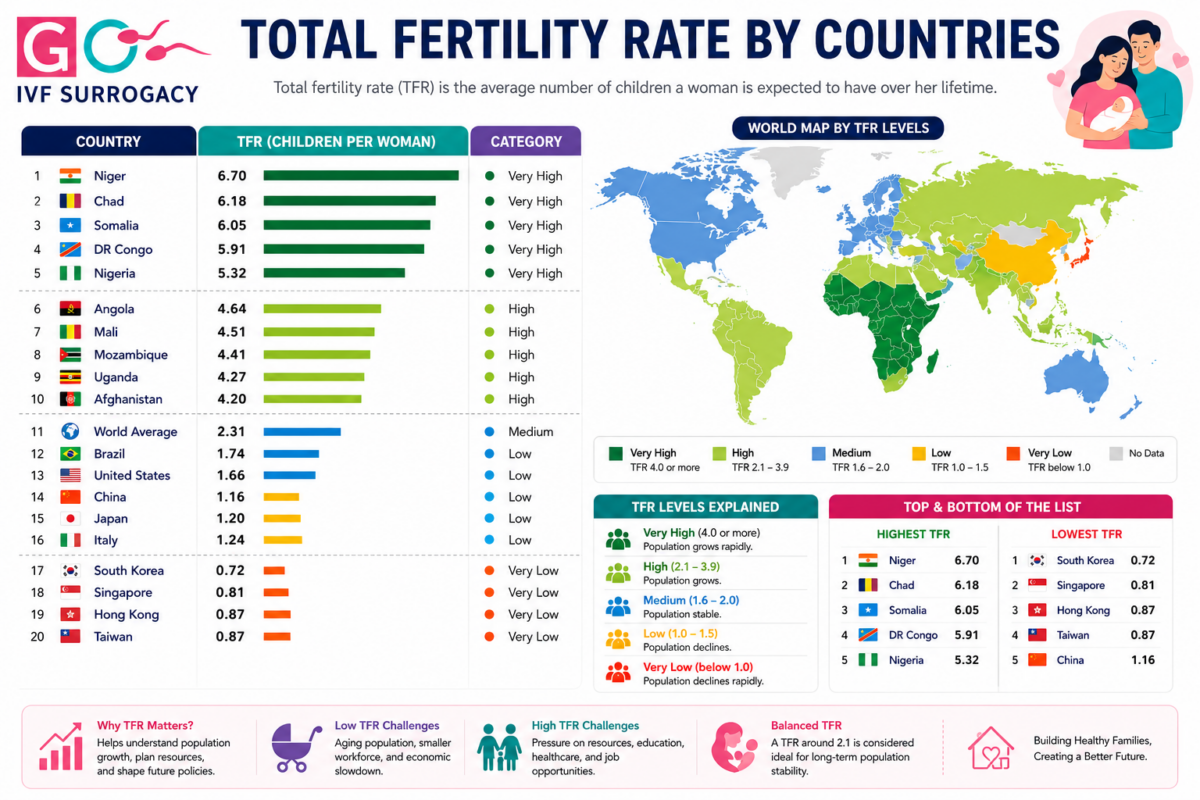
Total fertility rate by countries
What is the fertility rate? Before actually learning about the total fertility rate by countries we have to understand the meaning of the fertility rate.
Fertility rate
Fertility rate is the average number of children that would be born by one woman over her lifetime. Typically from the age of 15 to 49. Why? Because this is a typical window she would be fertile most in her life.
How is the fertility rate calculated?
The calculation of the general fertility rate of the country is measured by the Number of live births per 1000 women between the age of childbearing meaning 15 to 49 years yearly. In simple words, it is directly calculated by measuring how many children meaning, how many live births are happening per 1000 women between the childbearing age (15 to 49 years old).
The formula is a mathematical formula
- numerator: is the total number of live births recorded during that one year
- Denominator: Total media population of all the women in their reproductive years meaning between the ages of 15 to 49.
- Multiplier: multiplied by number 1000 women to make it easier to calculate.
Let’s take an example.
For instance, in country A, there were about 5000 live births in the previous year. And the population of women between the age bracket of 15 to 49 is about 1,00,000. So now , to calculate the general fertility rate of country A for that one year..
We have to divide the birth by the target population. Meaning we have to divide 5,000 live births by the estimated population of women, which is 1,00,000.
Then we would have something like a 0.05 answer.
Now furthermore we have to multiply this answer by 0.05 with then we would have 50.
Meaning the general fertility rate of country A is 50 lives per 1000 women of childbearing age.
Please note: There is NOT a country named as ‘A’, and this is just a general fertility rate. It is different from the total fertility rate by countries in which we have the total number of children one single lady is having throughout her life. Now let’s understand how to calculate that Total fertility rate
How to calculate the total fertility rate.
Total fertility rate is the lifetime calculation for an individual woman. Whereas the yearly or the annual rate of Per 1000 women is a general fertility rate. This is the difference between the two fertility rates.
Now if you want to calculate the total fertility rate or how many children one single woman is having throughout her life.
The answer was just right there. Meaning we just have to divide these 50 children not actually divide but like numerically divide these 50 figures of number we have just discovered in general fertility rate by per thousand women.
50\1000= 0.05 children per woman per year.
Now it means that each woman is having 0.05 children per year.
Now to understand how many children one single woman is having throughout her entire lifetime we have to consider the standard child bearing age which spans over 35 years from the age of 15 to 49 years old.
Let’s assume, she continues to have 0.05 children per year across those 35 years then it would mean that she would have 1.75 children throughout her lifetime. By multiplying 0.05*35= 1.75. So the total fertility rate is 1.75 children born.
Important note: a real woman cannot give birth to 0.05 children or something like 0.75 children. ‘Dramatically eye roll’ let’s be honest. You must have doubts about, What are the numbers and what is the meaning of these numbers?
So lets understand what this 0.05 children per year actually means? In a given year most individual women do not give birth at all meaning zero children. While other few women do give birth meaning one child or let’s say twins.
If you take a sample of 100 women in that age range. Like
- 90 women have zero children that year
- Five women have one child that year
- So the total children born to the group is five
When you spread these 5 children equally across all hundred women to find the statistical average 5 / 100 equals to 0.05.
It simply means that in any single year an individual woman has a 5% chance of having an actual baby. It does not mean that she has actually given birth tro five babies, it means she has a 5 percent chance of having a baby.
What does 1.75 children over a lifetime mean?
Of course a woman would not give just 1.75 children. It just means that average across millions of women.
Everyone has a different life path within that million population. Meaning some women will have three children or more than that whereas some of them would not even think about having children at all while some of them are just happy with two children.
Fertility rate by country 2026
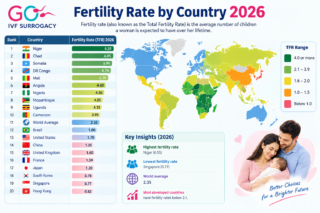
So there are about 195 countries in the world right now. When observing the total fertility rate by countries, this number does not mean that all 195 nations share the same demographic growth.
Each country’s fertility rate depends on various factors. Factors such as women’s education, economic cost and urbanization are the common things while contraception access still follows as the fourth number.
There are many other factors also which are the reasons and which actually actually affect the total fertility rate by countries across different regions.
First let’s understand which countries are the best, meaning at the very top of the fertility rate.
Top ten highest fertility rates country in 2026
So the top countries which have the top 10 highest fertility rate by the 2026 ranking are the most of them belonging to Africa, like the continent Africa.
| Chad | 5.84 |
| somalia | 5.81 |
| Democratic Republic of congo | 5.80 |
| Central african republican | 5.69 |
| Niger | 5.64 |
| Mali | 5.3 |
| Angola | 4.89 |
| Burundi | 4.57 |
| Afghanistan | 4.56 |
| Mozambiue | 4.54 |
First is Chad. Which has a fertility rate of 5.84 children per woman.
Then Somalia 5.81 children per woman next follows the democratic republic of Congo where the fertility rate is 5.80 followed by the central Africa republic by the rate of 5.69 per woman. On the fifth number we have Niger, by its 5.64 total fertility rate. On the 6th we have Mali 5.33 children per woman. By the rate of 4.89 children per woman we have been Angola on the 7th position. Followed by the 4.57 children for women is Burundi.
On the 9th we have Afghanistan which is the only non-African country in the top 10 which has 4.56 children per woman. In the last 10 we have Mozambique by the rate of 4.54 children for women.
How is the total fertility rate affected?
- Male loneliness epidemic: Men are not able to get a wife.
- Women’s Higher Education and Empowerment: Giving education to women meaning they are empowered and they start to believe that just because they have a uterus they do not have to have a child.
- Housing and Childcare Costs: Rising housing and child care expenses has made the population re-thinking the decision to have a child.
- Urbanisation: City living reduces the economical value of agriculture family labour. Most of the couples who are living in the urbanised areas they have openly shared how much coming to city has a reused their desire to have a child of their own
- Female Control of Contraceptives : It is the most important one. In Africa contraceptives are not very accessible. That’s why when studying the total fertility rate by countries, there is a huge number of fertility rates from the countries of Africa. The countries where there is very good awareness about the sex education there is a chance that there is a low fertility rate.
- Career Stagnation and the Long-Term Motherhood Penalty :Another one factor is always female employment. If you are employing females, then they would understand that they are independent and they do not need to have children to sustain their insecurity.
- Improved Healthcare Facilities and Reduced Infant Mortality: with the improved healthcare facilities has reduced the rates of actually infants dying.
- Hiring Bias Stemming from Mandatory Parental Leave:Another factor is government parental leave and child subsidies actually influence the family size. In India maternity leave after having a child is mandatory however many employers do not want to follow that rule and some even go up to part to not even employ a female which also affects the women’s career and restarting the career after having a child is another kind of social pressure.
- The Ideological Gender Divide and Changing Cultural Roles:it is like the woman doesn’t want to be just defined by ability to have children and men are not even considering getting out of their house and taking a step out of their conservative thinking and traditional values. Women are forwarding into empowerment whereas the males are just stuck in that Medieval thinking .
Highest fertility rate in the World and why is it important to have the highest fertility rates?
Economists track the Total fertility rate by countries because it is essential. In what manner? because we have to grow and we are not immortal. We are all going to die one day so it is important that there is another generation waiting to understand the concept of sustainable development.
Like using the resources in a way so that the next generation have the same resources so if like let’s say there is no second generation. What is going to happen.
The country is going to die and it will become exthasinct. And even though humans are the most overpopulated species on the planet, it is still very important that we reproduce and continue to grow our numbers.
On top of that there are very significant reasons biologically and ecologically that even though humans are not apex predators directly in the ecosystem they still somehow directly impact the environment.
Why Fertility Rates Are Calculated in the First Place
-
Economic Planning and Workforce Size
Have you ever heard the term ‘capitalism’, So yeah it is one of the reasons that the human population must continue. Capitalism is sustained through the economic value of the country.
Measuring the birth rate allows governments and businesses to project future labor supply, identifying potential shortages or surpluses 18 to 20 years in advance.
-
Resource Allocation and Infrastructure
Of course not only capitalism is the reason for the tracking of Total fertility rate by countries across the globe. Many governments which come into power let’s say your country is Democratic, even if it is not in democracy. The ruler of the country and the political leader of the country must know how many people are actually born so they could provide the infrastructure for the people. and the infrastructure is education and health, two important factors..
All the cities which are redeveloped or being developed for the very first time need planning about how many people are going to live in that city.
-
Managing Pension and Social Security Systems
Another thing is the dependency ratio. It is like taking care of your old parents just like they took care of you when you were a child. But in this case they are not your parents but they are just some Old millennials or retired colleagues from your corporate system.
if the fertility rate drops too low meaning there is a whole lot of older people then the younger generation. Just like the case of Japan where the old population is more than younger generations.
Why High vs. Low fertiltiy Rates Matter
-
Why Low Fertility is the issue
- Increase of Aging Population: If the younger generation is not producing children it would mean there is a very high number of old age people who cannot work therefore they cannot sustain the economy of the country. That is bad.
- Economic Stagnation: Again there is a population for the big companies to have their consumers or have their customers the demands will reduce. It will lead to lower innovation meaning lower innovation in the technological way and lower income.
-
Why Fertility Above 4.0 is not good
Look at rapid population growth of India, but problems like unemployment homelessness and rising poverty and it would be very difficult for the people to actually come out of poverty.A massive influx of young people entering the job market without enough employment opportunities can lead to economic instability or social unrest.
- The Replacement Level (2.1): It is considered the miracle of the For the economists why? Because due to some kind of mathematical calculation they have done, any country with the Total fertility rate by countries baseline 2.1 will continue to grow without any stagnation and without any overpopulation.
Highest fertility rate in India
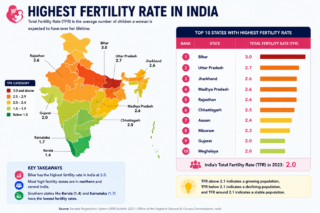
India is considered the most populated country in the world and it is not just the consideration it is true but despite the fact of being over populated, Evaluating the total fertility rate by countries shows that the rate of India is declining at a very rapid speed.
India’s national average total fertility rate has dropped to 2.0 which is below the global replacement level 2.1
Now let’s go through the buy one by one which has the biggest number of fertility rates in India.
- One of them is at the top which Bihar comes into the top by having 2.8 to 3.0 birth rates per woman.
- Next is Uttarpradesh 2.6 to 2.7 births per woman.
- Third, Madhya Pradesh by 2.4 to 2.6 births per woman.
- Next we have Rajasthan shockingly 2.3 to 2.4 births per woman.
- we have Jharkhand by 2.1 to 2.3 for women and
- On sixth it is Chhattisgarh with 2.2 births per woman.
| State with highest fertility rate in India | Highest Fertility rates |
| Bihar | 3.0 |
| Uttar Pradesh | 2.7 |
| Madhya pradesh | 2.6 |
| rajasthan | 2.4 |
| Jharkhand | 2.3 |
| chhattisgarh | 2.2 |
Lowest fertility rates in India
- Delhi: 1.2
- Sikkim: 1.1
- Andaman and Nicobar Islands (UT): 0.9
- Tamil Nadu, Kerala, and West Bengal: 1.3 per woman
- Punjab and Maharashtra: 1.4 per woman
- Andhra Pradesh and Jammu & Kashmir: 1.4 per woman
- Himachal Pradesh, Karnataka, and Telangana: 1.5 per woman
Top 10 countries with lowest birth rate
Both of the terms, The birth and the total fertility rate are the both different and distinctive demographic measurements.
Meaning they both look at the same subject however through the very different statistical views.
Birth rate, also known as crude birth rate is the measure about how many total children regardless of their genders are per 1000 people in the entire population in a given year of the entire country. Whereas total fertility rates by counties is the measurement of the average number of children a single woman could have throughout her whole lifetime..
Birth rate is an exact Measurement It is like a statistical fact whereas total fertility rates by countries is totally based on the current birth patterns.
It can change based on the patterns of the people people are having during that year.
Countries with lowest birth rates
| Country / Region | Total Fertility Rate | What This Means (Per 100 Women) |
| Macau | 0.70 | 100 women will have 70 children total |
| South Korea | 0.76 | 100 women will have 76 children total |
| Hong Kong | 0.84 | 100 women will have 84 children total |
| Taiwan | 1.00 | 100 women will have 100 children total |
| Singapore | 1.10 | 100 women will have 110 children total |
| Malta | 1.10 | 100 women will have 110 children total |
| Spain | 1.16 | 100 women will have 116 children total |
| Italy | 1.21 | 100 women will have 121 children total |
| Ukraine | 1.22 | 100 women will have 122 children total |
| Moldova | 1.26 | 100 women will have 126 children total |
Fertility rate Europe by country
| Fertility rate Europe by country | Fertility Rate |
| Montenegro | 1.75 |
| Bulgaria | 1.72 |
| France | 1.61 |
| United Kingdom | 1.56 |
| Iceland | 1.56 |
| Slovenia | 1.52 |
| Denmark | 1.47 |
| Ireland | 1.47 |
| Slovakia | 1.46 |
| Norway | 1.45 |
| Belgium | 1.44 |
| Sweden | 1.43 |
| Hungary | 1.41 |
| Germany | 1.36 |
| Austria | 1.31 |
| Finland | 1.25 |
| Greece | 1.24 |
| Italy | 1.18 |
| Poland | 1.14 |
| Spain | 1.10 |
| Malta | 1.01 |
| Ukraine | 0.99 |
Which country has the Highest fertility rate in Europe?
Monaco is the country in Europe which has the highest fertility rate of 2.10. If we compare the total fertility rate by countries across Europe, Monaco actually stands out as an exception..
Frequently asked questions
Is India the most fertile country?
Nope, even though the country is the most overpopulated in the world, it is not the most fertile country in the world Sean in the Total Fertility rate by countries list.
What is the fertility rate of India in 2026?
India’s total fertility rate in 2026 is 1.93 to 1.96 births for women per woman. Yes yes it is below the replacement fertility rate.
Is India’s fertility rate high?
No, India’s fertility is not high. While in the past it was considered that it was high in the 1950s and 1960s where the total fertility rate was at its historical peak around 5.9 to 6.1 children per woman.
What is the ideal fertility rate for a country?
The replacement fertility rate is 2.1. It is not too high, not too low so it is baseline. it is like you can have this kind of fertility rate for a country and your country would not have an overpopulation and it was it also would not have any kind of economic stagnation as well.