Best IVF Doctors 20 top ivf specialists in Mumbai
Having a child is a wonderful blessing that some people miss out on due to infertility or simply not being ready at the time. Across the world, experiences vary widely; from a seventy-year-old woman having a baby to young couples longing for their firstborn for years. People have children for many different reasons, and everyone’s path is unique.
Yet, they all share the exact same wish: wanting a baby.
Modern medical technology now makes the impossible possible through IVF, helping people achieve that dream. IVF is an artificial way to conceive a baby compared to natural pregnancy. So, Natural pregnancy happens through intercourse where semen and an egg merge inside the woman’s body.
pregnancy is the final stage of natural fertilization. Natural fertilization happens entirely within the body’s reproductive system without any outside help. And, IVF steps in when natural conception fails to happen.
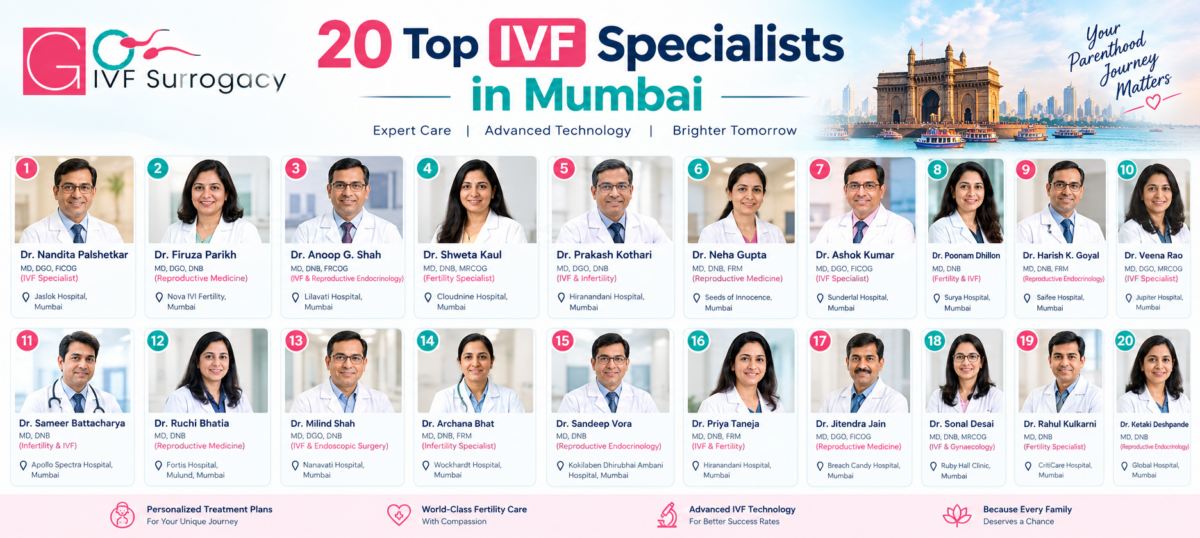
IVF is not a simple treatment , there are thousands of things patients need to look for, but that’s why Go IVF surrogacy is here. If you are seeking guidance, finding a trusted 20 top IVF specialists in Mumbai can make all the difference, and Go IVF surrogacy will tell you who are the best twenty top ivf specialists in Mumbai, you can choose from.
Twenty top ivf specialists in Mumbai
When looking for a 20 top IVF specialists in Mumbai , patients often wonder why certain medical professionals stand out. Why are these considered the top twenty IVF specialists?
- Long track record of work and experience
The first and more important thing was that priority was actually given to the doctors who are pioneers in India’s reproductive medicine field.
For example Dr. Firuza Parikh has led the team beyond the numbers of early ICS breakthroughs at Jaslok hospital. And for Dr. Hrishikesh Pai and Dr Nandita palshetkar, these two doctors have a long track record of an experience from all over the country of more than three decades.
Working with a renowned 20 top IVF specialists in Mumbai ensures you get seasoned expertise.
- Hospital and IVF centre play a big role
Second, selection was focused on doctors affiliation with the known IVF centers or the hospitals. Because not only the doctors play the role but also the institution you are going to seek a treatment also plays the biggest role in your IVF your treatment as well.
Medical infrastructures such as the Jaslok hospital and Lilavati hospital are the highly specialized and accredited fertility centers around Mumbai and they are frequently housing the 20 top IVF specialists in Mumbai.
- What are their advanced technological capabilities
The third factor is thatIVF success is actually depending heavily on embryology lab standards.
The lab in which the embryologists prepare and operate on a daily basis has to be equipped with advanced laboratory setups.
It includes facilities for ICSI treatment and pre-implantation genetic testing also known as PGT and PGD testing. And many more of course. When you consult a 20 top IVF specialists in Mumbai , these cutting-edge lab standards are standard practice.
- What are the specializations in the complex cases
Of course the case is what is the specialization of the said doctor in the complex cases. A good doctor is not the only one who has a big number of experience but also what are their areas of specialization in which they absolutely rock.
Choosing a 20 top IVF specialists in Mumbai helps navigate these complex scenarios effectively.
IVF is not just a simple strategic treatment it needs a very careful and proper diagnosis. And sometimes IVF is needed not only because the patient has normal infertility issues.
One of the biggest reasons for IVF is unexplained fertility issues. In that case choosing a doctor who has had experience with advanced and complex cases would be a plus point.
- What about the recognition in the field
These doctors have held or currently hold leadership positions in major national bodies. Such as Indian society of assisted reproduction (ISAR) and Federation of obstetric and gynecological societies of India (FOGSI). These societies actively contribute through their doctors towards clinical research in peer reviewed publications as well.
Every recognized 20 top IVF specialists in Mumbai are tied to these prestigious organizations.
| Twenty top ivf specialists in Mumbai | |||
|---|---|---|---|
| Doctor Name | Specialty / Focus | Hospital / Clinic | Location |
| Dr. Firuza Parikh | Reproductive Medicine & IVF | Jaslok Hospital & Research Centre | Pedder Road |
| Dr. Hrishikesh Pai | Infertility & Reproductive Medicine | Bloom IVF / Lilavati Hospital | Bandra West |
| Dr. Nandita Palshetkar | IVF & Reproductive Technologies | Bloom IVF / Lilavati Hospital | Bandra West |
| Dr. Sulbha Arora | Reproductive Endocrinology & IVF | Nova IVF Fertility / Lilavati Hospital | Bandra West |
| Dr. Jay Mehta | IVF & Advanced Reproductive Surgery | Shree IVF Clinic | Ghatkopar West |
| Dr. Jatin Shah | Infertility & IVF Specialist | Mumbai Fertility Clinic & IVF Centre | Grant Road |
| Dr. Asha Dalal | Infertility & Gynecology | Sir H. N. Reliance Foundation Hospital | Girgaon |
| Dr. Radhika Sheth | Reproductive Endocrinology & IVF | Luma Fertility | Bandra West |
| Dr. Ritu Hinduja | Reproductive Medicine & IVF | Cloudnine Fertility | Malad West |
| Dr. Rishma Pai | IVF & Gynecological Endoscopy | Jaslok Hospital / Lilavati Hospital | Pedder Road / Bandra West |
| Dr. Ankesh Sahetya | Infertility & Reproductive Care | Pushpaa Hospital | Andheri West |
| Dr. Hitesha Ramnani Rohira | IVF & Fertility Specialist | Kokilaben Dhirubhai Ambani Hospital | Andheri West |
| Dr. Richa Jagtap | Reproductive Medicine & IVF | Nova IVF Fertility | Chembur / Andheri |
| Dr. Vidya Patil | Gynecology & IVF Treatment | Arya Women’s Hospital | Kandivali West |
| Dr. Navina Singh | Infertility Specialist | Birla Fertility & IVF | Prabhadevi |
| Dr. Manjushri Kothekar | Reproductive Medicine | Bavishi Fertility Institute | Ghatkopar West |
| Dr. Kanika Kalyani | Reproductive Medicine & IVF | Indira IVF Centre | Borivali West |
| Dr. Raju Sahetya | Gynecologist & Infertility Specialist | Pushpaa Hospital | Andheri West |
| Dr. Amol Wankhede | Reproductive Medicine & IVF | Indira IVF Centre | Lower Parel / Dadar |
| Dr. Vaishali Killekar | Gynecology & Infertility | Mauli Aarogyam Hospital | Malad East |
Best ten IVF doctors in Mumbai for different specialities
IVF is not just one time treatment, it takes and goes over a month of Phases. There are many stages in the IVF treatment and in each stage there are different kinds of treatments. So it is a multi-step biocellular process.
Because of this IVF requires a multi-specialist team.
Within IVF and reproductive medicine, doctors and specialists specializes in distinct physiological surgical, laboratory or genetic subfields.
- Reproductive endocrinology and infertility.
- Clinical embryology
- Andrology and male reproductive health
- Reproductive surgery is such as laparoscopy and hysteroscopy
- Pre implantation genetics and reproductive genomics
- Oncofertility and medical preservation
- Third party reproduction
Consulting a trusted 20 top IVF specialists in Mumbai can streamline your journey through these specialties.
All these as a specialization under the umbrella of in vitro fertilization. Not only this, in IVF the doctor you are choosing is also based on what is the exact cause of your infertility.
Doctors who actually specialize in that specific condition are a must.
For example, if there is severe male factor infertility then the primary specialist needed in this case would be andrologist or reproductive urologist. Why? This specific specialist is required because these kinds of specialists perform specialized surgical sperm retrievals or repair any kind of damage or any kind of problem with the male testicles before handing the sperm to the embryologists.
If infertility is caused by mild tubal blockage, mild ovulation delay or unexpected unexplained factors then a single primary IVF specialist can actually manage the entire treatment from start to finish.
However, when this infertility involves severe male factors, structural uterine problems, genetic risks, so your primary IVF 20 top IVF specialists in Mumbai act as a team lead in collaboration with the sub specialists such as andrologist for a partner or reproductive surgeon for the uterine prep.
| Best ten IVF doctors in Mumbai for different specialities | ||
|---|---|---|
| Condition | Specialist | Hospital / Clinic |
| Blocked / Damaged Tubes | Dr. Neeta Warty | Jaslok Hospital / Breach Candy |
| Hydrosalpinx | Dr. Shreedevi Tanksale | Little Miracles Fertility Clinic, Opera House |
| Prior Tubal Ligation | Dr. Prashant Mangeshikar | P. D. Hinduja Hospital / Breach Candy |
| PCOS / PCOD | Dr. Duru Shah | Gynaecworld Clinic, Kemps Corner |
| Diminished Ovarian Reserve (Low AMH) | Dr. Hrishikesh Pai | Lilavati Hospital / Bloom IVF, Bandra |
| Premature Ovarian Insufficiency (POI) | Dr. Suchitra Pandit | Surya Hospitals, Santacruz |
| Hypothalamic Amenorrhea / Anovulation | Dr. Kedar Ganla | Ankoor Fertility Clinic, Dadar |
| Endometriosis (Deep Infiltrating) | Dr. Vivek Salunke | Nalini Hospital / Lilavati Hospital |
| Adenomyosis | Dr. Pratik Tambe | Ashirwad IVF Clinic, Bhandup |
| Submucosal Fibroids & Polyps | Dr. Rekha Ambegaokar | Nanavati Max Hospital, Vile Parle |
| Asherman’s Syndrome (Uterine Scarring) | Dr. Jay Mehta | Shree IVF Clinic, Ghatkopar |
| Congenital Uterine Anomalies (Septum) | Dr. Uddhavraj Dudhedia | Nanavati Max Hospital, Vile Parle |
| Refractory / Thin Endometrium | Dr. Neelam Bhise | Acme Fertility, Chembur |
| Recurrent Implantation Failure (RIF) | Dr. Firuza Parikh | Jaslok Hospital |
| Thrombophilia & Autoimmune Factors | Dr. Ritu Hinduja | Cloudnine Fertility, Malad / Khar |
| Sperm Quality & Quantity (Oligo/Astheno/OAT) | Dr. Srikant Pai | Symphony Health Care, Andheri |
| Obstructive Azoospermia | Dr. Dilip Raja | Dilip Raja Urology Centre / Saifee Hospital |
| Non-Obstructive Azoospermia | Dr. Rupin Shah | Lilavati Hospital / Bhatia Hospital |
| High Sperm DNA Fragmentation (DFI) | Dr. Sanjay Nabar | Nanavati Max Hospital, Vile Parle |
| Ejaculatory Dysfunction | Dr. Dilip Raja | Saifee Hospital / Hindujai Hospital |
| Anti-Sperm Antibodies | Dr. Srikant Pai | Symphony Health Care, Andheri |
| Single-Gene Disorders (PGT-M) | Dr. Firuza Parikh | Jaslok Hospital |
| Structural Translocations (PGT-SR) | Dr. Prochi Madon | Jaslok Hospital |
| Age-Related Aneuploidy (PGT-A) | Dr. Hitesha Ramnani Rohira | Kokilaben Dhirubhai Ambani Hospital, Andheri |
| Unexplained Infertility | Dr. Gautam Allahbadia | Rotunda Center, Parel |
| Oncofertility / Medical Preservation | Dr. Nandita Palshetkar | Lilavati Hospital / Bloom IVF, Bandra |
| Third-Party Reproduction | Dr. Richa Jagtap | Nova IVF Fertility, Chembur / Andheri |
What are the IVF doctor patient reviews Mumbai
To know any particulate doctors patient review of mumbai,, you can go to their pages or official Clinical or hospital website. Otherwise there are several reddit communities to share their experience with the doctors.
Additionally if you consult 20 top IVF specialists in Mumbai , it will guarantee you accessible patient testimonials and high satisfaction scores.
What are the IVF doctor qualifications in Mumbai
To know any particulate doctors qualification, you can go to their pages or official Clinical or hospital website. Moreover Credentials and training are important when selecting the 20 top IVF specialists in mumbai.
Top IVF doctors in Mumbai with top success rate Mumbai
| Doctor Name | Reported IVF Success Rate (Clinic / Center) |
| Dr. Firuza Parikh | 47% to 51% cumulative per couple |
| Dr. Nandita Palshetkar | 65% to 75% |
| Dr. Hrishikesh Pai | 65% to 75% |
| Dr. Indira Hinduja | 40% to 50% per cycle average |
| Dr. Jatin Shah | 45% to 55% per cycle average |
| Dr. Anjali Malpani | 40% to 45% per cycle (for patients under age 35) |
| Dr. Kedar Ganla | 40% to 50% per cycle average |
Note: In IVF medicine, individual success rates depend heavily on patient age, baseline AMH levels, underlying condition, and whether donor eggs or pre-implantation genetic testing (PGT) are utilized.
On what factors success rates depend ?
- Female Age
- Ovarian Reserve (AMH & AFC)
- Egg Quality
- Sperm Health & DNA Fragmentation (DFI)
- Embryo Grade & Blastocyst Development
- Embryo Genetic Health (Euploidy / PGT-A)
- Endometrial Thickness & Pattern
- Uterine Cavity Structure
- Pelvic Health (Hydrosalpinx & Endometriosis)
- Endometrial Receptivity
- Absence of Chronic Endometritis / Infection
- Hormonal Stimulation Protocol
- Embryology Lab Air Quality & Incubation Standards
- Lab Capabilities (ICSI, IMSI, Time-Lapse etc.)
- Embryologist Skill
- Transfer Protocol (Fresh vs. FET)
- Body Mass Index (BMI)
- Systemic Health (Thyroid, Diabetes, Autoimmune
- Smoking & Lifestyle Exposure
- Vitamin D & Metabolic Levels
Top Five IVF Centre in Mumbai
There are many IVF and fertility clinics in India that help couples who are having trouble conceiving. Some well-known names include Go IVF Surrogacy, Select IVF, World Fertility Services, We Care Health Services, and Indira IVF in Mumbai.
Go IVF surrogacy
Go IVF Surrogacy is a fertility and surrogacy service around the word and India that helps people explore different options for starting a family. The clinic focuses on fertility treatment and related support.
Not only that, the clinic also has in- house, many specialists who help people with treatment themselves. Below is the list of treatments Go IVF Surrogacy offer
- IVF
- Gestational Surrogacy
- Self-Egg Surrogacy
- Donor-Egg Surrogacy
- In Vitro Fertilization (IVF)
- Intracytoplasmic Sperm Injection (ICSI)
- Intrauterine Insemination (IUI)
- Egg Donor Programs
- Sperm Donor Programs
- Embryo Freezing & Vitrification
- Legal Documentation & Surrogate Coordination Support
- Phone: +91-9883999000
- Email: info@ivfsurrogacy.in
- Website: https://www.ivfsurrogacy.in
- Address: 26/18, West Patel Nagar, New Delhi – 110008, India
Select IVF
- Self-Eggs IVF
- Donor-Eggs IVF
- Self-Eggs Surrogacy
- Donor-Eggs Surrogacy
- Altruistic Surrogacy Programs
- Phone: +91-8447592299
- Email: info@selectivf.com
- Website: https://selectivf.com
- Intracytoplasmic Sperm Injection (ICSI)
- Intrauterine Insemination (IUI)
- Egg Freezing & Vitrification
- Donor Programs (Egg, Sperm, and Embryo)
- Multiple-Attempt / Guaranteed Packages
World fertility services
Services offered by World fertility services
- In Vitro Fertilization (IVF)
- Intracytoplasmic Sperm Injection (ICSI)
- Intrauterine Insemination (IUI)
- Gestational SurrogacyDonor Programs (Egg & Sperm)
- Embryo Cryopreservation
- Male & Female Infertility Treatment International Patient Care Coordination (Appointments, Travel, and Accommodation)
Nova IVF Hospital
Nova IVF is a fertility and IVF centre in Mumbai that helps couples who are having difficulty getting pregnant. Additionally, provide treatments such as IVF, IUI and other fertility treatments. They have centres in different parts of Mumbai, including Andheri, Chembur and other locations.
Indira IVF, Mumbai
Indira IVF is a well-known IVF and fertility centre in Mumbai. Moreover, it has several centres across the city, including Borivali, Andheri, Dadar, Ghatkopar and Bhandup , also They help couples with fertility problems and provide treatments like IVF and other fertility services.
Best IVF centre in Mumbai?
Go IVF SURROGACY is the best IVF centre in Mumbai.
Gaudium IVF Mumbai
Gaudium IVF was founded in Mumbai by Dr. Manika Khanna, laparoscopic surgeon and infertility specialist. It has Nationwide chain of specialized fertility and women’s health clinics known for handling challenging cases, multiple failed IVF cycles, and customized stimulation protocols.
Additionally it is equipped with advanced embryology labs, AI-driven embryo assessment tools (such as ERICA for endometrial receptivity timing and SiD for sperm evaluation), time-lapse incubators, and advanced vitrification.
Gaudium ivf best ivf centre in mumbai reviews
Gaudium ivf best ivf centre in mumbai reviews has positive reviews from its patients.
Bloom IVF Mumbai
Bloom Founders: Dr. Hrishikesh Pai and Dr. Nandita Palshetkar (established in 1991)
Multi-city fertility network specializing in simple and complex reproductive treatments, recurring IVF failure management, and advanced ART.
How to schedule a consultation with an IVF doctor in Mumbai
- Call the hospital or private clinic reception directly via their official phone lines to book a physical OPD time slot.
- As for the multi-specialty hospital helpdesks e.g, Jaslok, Lilavati, Nanavati, Hinduja to secure appointments with visiting or resident IVF consultants you should visit the hospital itself.
- Use verified healthcare portals like Practo, Justdial, or hospital-specific web portals to select an available date and time slot with a qualified 20 top IVF specialists in Mumbai.
How to schedule an IVF specialist online consultation in Mumbai?
First visit the clinic’s web portal and navigate to their “Book Online Consultation” or “Tele-consultation” section to fill out scheduling forms.
Message the clinic’s designated patient care helpline numbers to request a video or phone consultation link with the assigned specialist.
Book virtual video appointments through integrated medical aggregator apps that feature certified Mumbai reproductive endocrinologists and fertility specialists.
Frequently asked questions?
-
What is the cost of IVF procedure at the top IVF centre in Mumbai?
The cost of IVF procedure at the top IVF centre in Mumbai varies from Rs 1.5 lakhs to rupees 2.5 lakhs, excluding any genetic testing. Clinic fame plays a big role in the IVF cost in Mumbai.
-
What is the consultation cost of a top IVF doctor in Mumbai?
Top centres in Mumbai charge more than those in suburbs like Andheri or Borivali. Location matters because city-centre spots have higher rents, so fees climb. But you should expect something 5000 rupees from the start of consultations with 20 top IVF specialists in Mumbai.
-
How to make sure I have the best IVF results?
- Keep your body weight in a healthy range
- Quit smoking, vaping, and drinking alcohol
- Take your prenatal vitamins like folate, vitamin D, and CoQ10
- Get your thyroid and blood sugar levels under control
- Complete all your initial blood tests and hormone panels
- Check your uterus with a scan or minor procedure beforehand
- Test for male factor issues and sperm DNA damage early on
- Choose a fertility doctor who has plenty of experience
- Pick a clinic that has a top-tier embryology lab
- Look into genetic testing (PGT-A) for your embryos
- Go with a frozen embryo transfer if your hormone levels are too high after stimulation
- Follow your medication schedule strictly for injections and trigger shots